Robots.txt vs Robots tag vs Schema and more, Dummies Explained
Yee Sen Low
Founder, Yeeclick Studio
16th August 2026
10 mins read

Introduction
I get it. Some SEO's 'magic' files and tags can be confusing.
When you look at their function at first glance, their roles look like they overlap. But trust me, they are there for a specific purpose.
You might know how to use them, follow a certain way. Still, if you're always flying blind with a fixed procedure, you won't just risk getting replaced by AI, you're gonna fly straight into a wall someday.
This article is meant for SEOs who want to know what they are working with.
I am just gonna do a quick run through on how search engines work, so you can see where each of these files and tags fits in.
I won't cover every single one, but I'll cover the common ones you might run into:
Root level files
- robots.txt
- sitemap.xml
Part of HTML
- meta tags
- canonical tag
- hreflang tag
- meta OG tags
- alt text
- schema markup
How search engines work and when those tags and files function
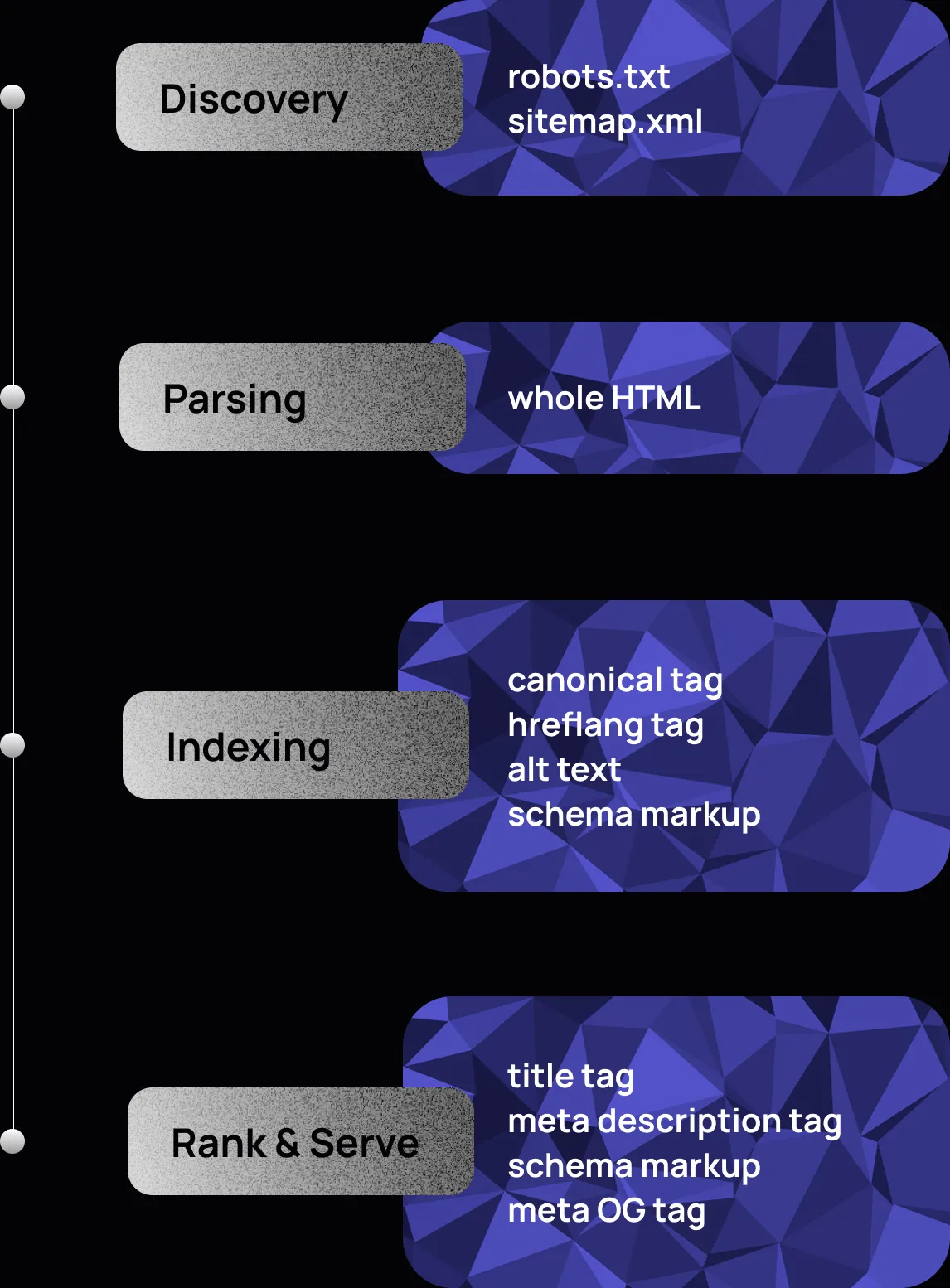
1. Discovery:
After you have a new page, search engine crawlers can find your page in a few ways:
- Routine crawl
- Sitemap
- Page by page request
Routine crawl vs Sitemap
Routine crawl might miss your site if you have orphaned pages that have no internal links pointing to them, or you have a deep site with many layers of navigation links.
With sitemap.xml, you show a clear roadmap of which URLs they should crawl, with an optional <lastmod> tag for a freshness signal.
Before it touches anything, it will check your robots.txt at the root files. This step will determine which paths the crawler is even allowed to look at.
2. Parsing for Bots:
If crawling is allowed, Googlebot/Bingbot will fetch the HTML, run JavaScript to see the fully rendered page. Bots will process and collect everything: visible content, tags in the header, alt text, schema markup and so on.
Just in case you don't know, a webpage consists of three things: HTML, CSS, JavaScript.
HTML (HyperText Markup Language) is the skeleton and framing of a website; it decides the structure. CSS makes it look good. JavaScript makes it interactive.
HTML is what matters for SEOs; it basically says "these things exist here and here is their basic shape."
HTML has two parts:
Within <head></head>, this is the "backstage," most SEO-related tags are here.
Within <body></body>, this is the visible page, where all the text and images are placed.
Visible content vs alt text vs schema markup
Visible content is the primary way bots understand your content.
Alt text is the explanation for an image and help visually impaired users understand visual content.
Schema markup is used to remove the ambiguity from your content.
Search bots and AI bots will guess your content based on where you place the content, what the surrounding content is, or the structural symbol.
However, imagine if you use a word like "Fine." You meant to say the penalty fee, but somehow bots interpret it as good quality. Or you have a number in your online store which is supposed to be a product count, but bots interpret it as a price. Schema markup is there to clear that up.
The data shows that well-formatted structured data is highly correlated with AI bot preference, so schema markup is increasingly important compared to the past.
How about llms.txt?
You might have heard of llms.txt. A root-level file marketed as a cheat sheet that tells AI systems which pages matter. But its actual effect is still controversial. With no concrete proof it works, I'm leaving it out of this article.
3. Indexing:
With the info of the page, bots first check the robots meta tag to see if this page is allowed to be indexed.
Bots will check if the page is a duplicate of another page. This is when the canonical tag and hreflang tag have a role. Canonical tag set which version you want to be indexed and hreflang tag set which regional/language version should show to searchers. If you do not set it, Google will decide for you.
Bots also check the quality of your page, which can be determined by whether the page has keyword stuffing, scraped content, AI slop, thin content, or bad page experience (slow load, too many pop-ups...).
robots.txt VS robots meta tag
You might wonder why we need to decide if the page should be indexed using the robots meta tag if we can stop the page from being crawled with robots.txt.
This is a really common misunderstanding.
robots.txt is actually not reliable for stopping a page from being indexed, because if bots crawl another page with links to the site, it might still get indexed. To make sure it is not indexed, you need to use the robots meta tag.
Robots.txt is used to reduce the workload of bots. If you have a massive site, you want the crawler to focus on the new pages that haven't been indexed yet; in this case, you can use robots.txt to control the crawl budget.
X-Robots-Tag vs robots meta tag
They have similar function.
But X-Robots-Tag can be used for any file, like a PDF or image, while the robots meta tag can only be used for HTML files because, well, PDF or image do not have header like HTML.
X-Robots-Tag is written at the server level, not in any root file or in HTML.
4. Ranking and serving:
Ranking is the most "black box" part of the SEO world; it's not controlled by a single tag or file. Search engines look at many factors to determine how they should order the results.
Serving is the very final step to show the result to the user. What matters here is the HTML title tag, meta description tag, and schema markup. Unlike schema markup, which also helps bots understand your content, the meta description only affects how the search engine shows the result.
One thing to notice is that the search engine might still decide the title and description in the SERP on its own, despite the page having a title tag and meta description tag.
A well-built schema markup for a page might lead to a rich result, which means extra visual or interactive elements beyond the standard blue links.
How about OG (Open Graph) tags? They are not part of the search engine pipeline. They are used to control what your link looks like when you share it on social media.
Flying with eyes opened, well, at least one of them
Now you know why we submit sitemaps instead of waiting for bots to crawl. Why robots.txt isn't the same as the robots meta tag or X-Robots-Tag. Why we use visible content, alt text, and schema markup to explain the page. What the title tag, description tag, and schema markup each do when showing results. And more.
These are not everything, but that's already more than most people running SEO on autopilot ever bother to check. If all you did was follow a checklist for SEO, if something goes wrong you might not know where to fix it. You can ask an AI assistant for that, of course, but I personally don't trust it fully, not with how often AI still hallucinates.

Meet Yee Sen
Precise, detail-oriented, and intensely passionate.
With total dedication, Yee Sen helps business owners and coaches optimize their systems and scale their revenue.
From building fiber optic network to building funnels, his engineering mindset stays the same: precise, detail oriented, and passionate.
With total dedication, Yee Sen helps business owners and coaches optimize their systems and scale their revenue.
